Research Program

Processing-Structure-Property Relationships in Polymeric Materials

Vision

Understanding and controlling processing-structure-property relationships in polymeric materials represents a central challenge in materials science. While synthetic polymers offer unprecedented tunability, translating molecular-level control into functional, hierarchical architectures remains limited by our understanding of how processing conditions govern structural organization across length scales.

Our central hypothesis: Controlled processing conditions and selective polymer interactions can impart sophisticated functionality to polymeric materials by optimizing their molecular organization and physical properties.

This research vision centers on three interconnected mechanisms: morphology control through processing conditions, chain alignment effects from processing-induced orientation, and additive integration governed by coupled hydrodynamic and thermodynamic effects.

Research Thrusts

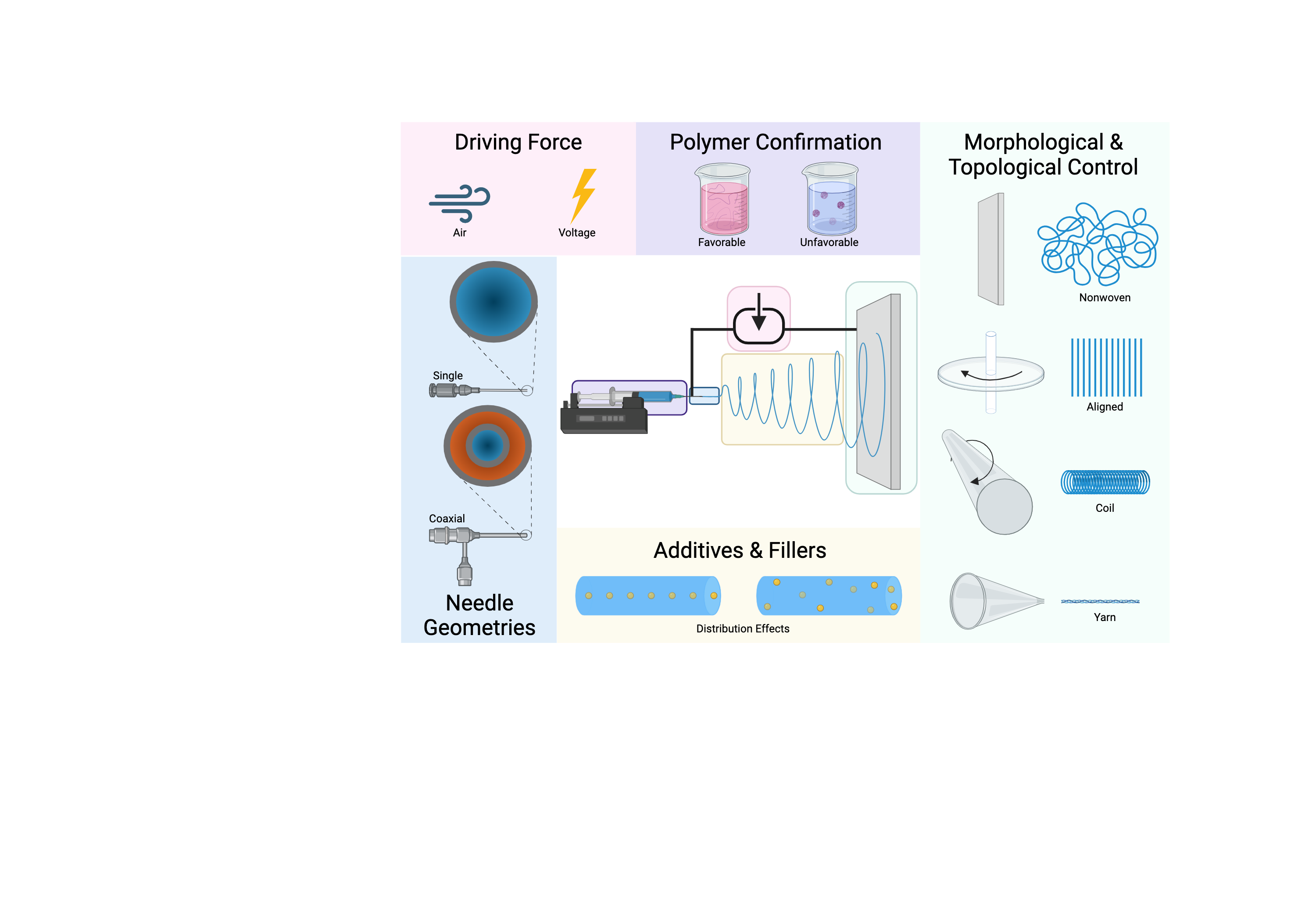
Solution blow spinning schematic showing fiber formation process
Research Thrust 1

Aligned Innovations: Polymer Dynamics for Optimized Nanofiber Performance

Solution blow spinning (SBS) offers a scalable alternative to electrospinning, using high-velocity gas flow to induce jet elongation without electrical fields. This project establishes quantitative relationships between SBS processing parameters and resulting fiber structure to enable predictive control over nanofiber properties for sensing and energy harvesting applications.

Key objectives: Map the processing window for stable fiber formation, develop methods for controlled aligned nanofiber bundles, and investigate additive incorporation effects on jet stability and final properties.

Target metrics: Piezoelectric response >30 pC/N, strain sensitivity >5 mV/ε, power density >1 μW/cm².
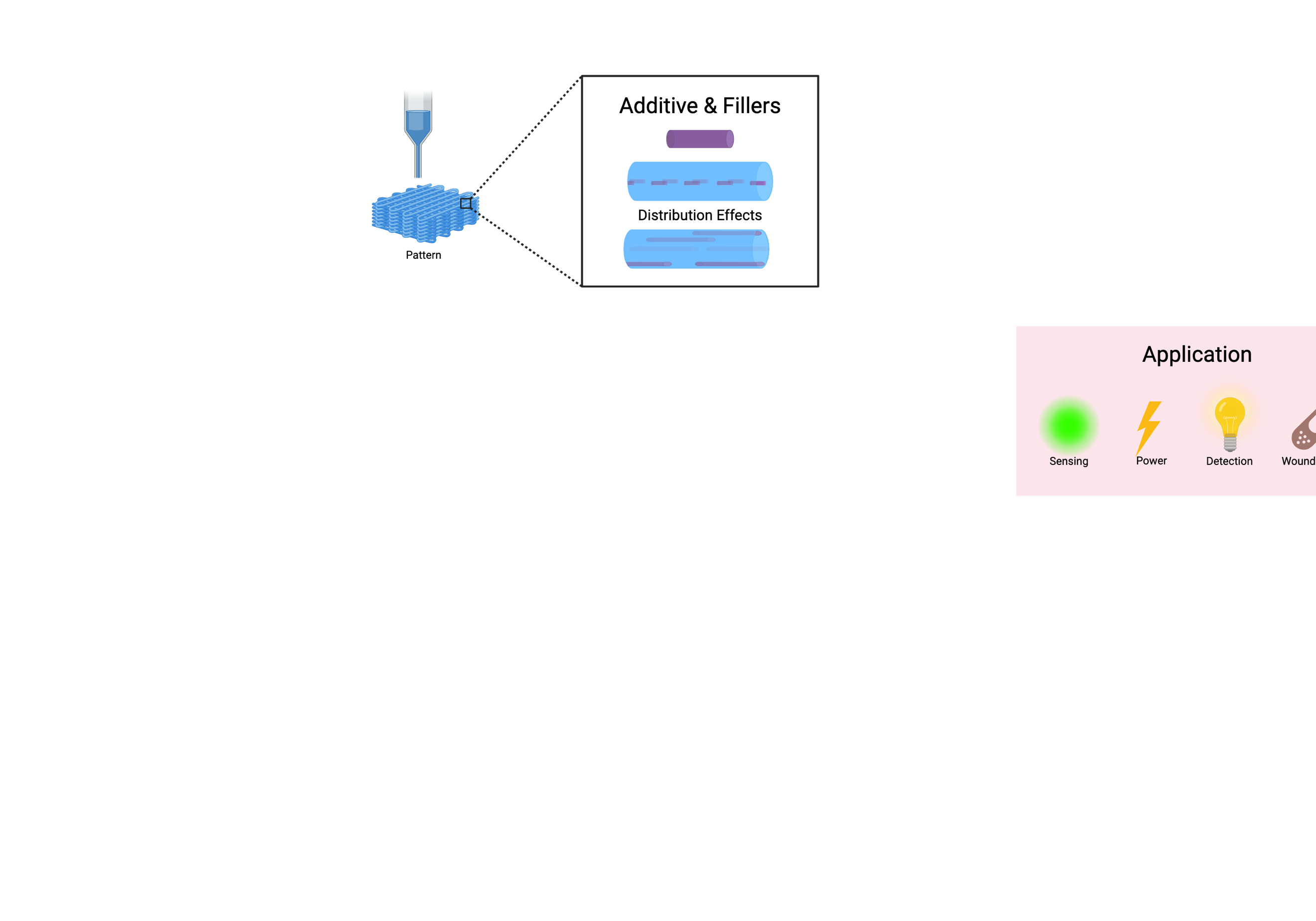
Bioprinting schematic showing direct ink writing process and applications
Research Thrust 2

Align & Print: Steering Cell Differentiation Through Additive Bioprinting

Direct ink writing (DIW) bioprinting presents unique opportunities to investigate how processing-induced alignment across multiple length scales—molecular, fibrillar, and cellular—influences biological outcomes. This project establishes fundamental relationships between DIW processing parameters, hierarchical structural organization, and cellular response.

Tissue targets: Skin (0.1-2 MPa, multi-directional fibers), muscle (8-17 kPa, parallel alignment for myotube formation), tendon (200-400 MPa, highly aligned architecture).

Target metrics: Elastic moduli tunable to tissue-specific requirements, cell alignment exceeding 80% within 15° of preferred direction, viability >90%.

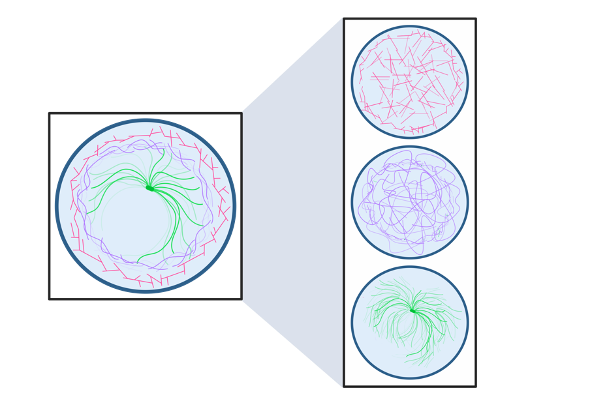
Artificial cytoskeleton networks in confined environments
Research Thrust 3

Artificial Cytoskeleton Assembly: Polymer Physics in Biomimetic Environments

The cytoskeleton exemplifies hierarchical organization arising from molecular-scale interactions. This project applies principles of polymer physics to investigate cytoskeletal assembly and mechanics in artificial cellular environments, using cell-free protein synthesis (CFPS) within micron-scale polymer droplets.

Key questions: How do crowding and confinement affect filament assembly kinetics and network topology? How do electrostatic and steric interactions between synthetic polymers and biopolymers influence network mechanics?

Applications: Micromotors, stimuli-responsive materials, targeted delivery systems, and platforms for investigating active matter behavior.

Broader Impact

This research program addresses critical challenges in controlling molecular organization across hierarchical length scales. By combining advanced characterization, computational modeling, and rational materials design, this work generates insights applicable across fields—from functional materials to biophysics.

The interdisciplinary nature of this research provides exceptional training opportunities for students in polymer physics, materials processing, and biomedical applications. Through collaborative efforts with computational scientists, biologists, and clinicians, we develop scalable, cost-effective materials that advance both fundamental science and practical applications.

Interested in Collaborating?

I welcome collaborations with researchers in polymer science, bioengineering, computational modeling, and related fields.

Get in Touch